Grease Trap Size Calculation: Litres per Second for Your Kitchen

Quick answer
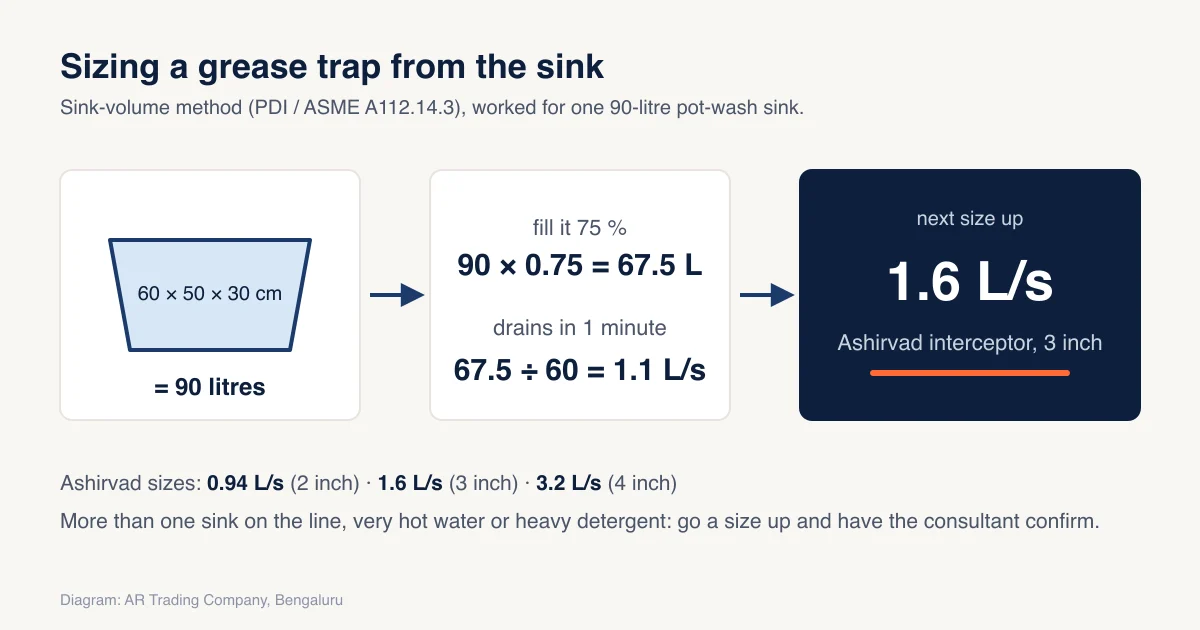
Size a grease trap by the rate water reaches it, in litres a second. For one sink, take its volume, multiply by 0.75 (a sink is rarely filled to the brim) and divide by the 60 seconds it takes to drain: a 90-litre sink gives 1.1 L/s, so choose the next size up, 1.6 L/s. Add the sinks that can drain at the same time, and go up a size for very hot water or heavy detergent.
Method 1: from the sink (PDI / ASME)
This is the method used with interceptors tested to ASME A112.14.3, which is the standard Ashirvad's interceptors are rated to.
- Volume of the sink. Length × width × depth in centimetres, divided by 1,000, gives litres. A 60 × 50 × 30 cm pot-wash sink holds 90 litres. For a two- or three-bowl sink, add the bowls.
- Times 0.75. Sinks are filled to about three quarters: 67.5 litres.
- Divide by the drain time. One minute is the usual design time: 67.5 ÷ 60 = 1.1 litres a second. A two-minute drain halves it, but one minute is the safer figure.
- Pick the next size up. 1.1 L/s needs the 1.6 L/s unit.
The same method sets a minimum grease capacity: in pounds, twice the flow in gallons a minute. For the three Ashirvad sizes that is 13.6, 22.7 and 45.4 kg; their tested capacities are higher, at 18.4, 33.6 and 55.3 kg.
Method 2: EN 1825 factors
The European standard sizes a separator from the peak flow and then multiplies it for the conditions it will face (British Water's code of practice):
- Hot water: × 1.3 if the waste water is above 60 °C.
- Detergents and rinse agents: × 1.3, and 1.5 or more for hospitals and other heavy users.
- Density of the fat: a factor for animal fats and heavy oils.
So one sink at 0.95 L/s with hot water and detergent becomes 0.95 × 1.3 × 1.3 ≈ 1.6 L/s. As a reference point, Qatar's public works specification takes one restaurant kitchen sink as about 0.95 L/s.
Ashirvad sizes
| Your figure | Choose | Pipe |
|---|---|---|
| Up to 0.94 L/s | 0.94 L/s interceptor | 2 inch |
| 0.95 to 1.6 L/s | 1.6 L/s interceptor | 3 inch |
| 1.6 to 3.2 L/s | 3.2 L/s interceptor | 4 inch |
| Above 3.2 L/s | Two units, one per wash area, or a larger in-ground separator |
Ashirvad's list prices, including taxes:
| Rated flow | Pipe | Holds | Grease before cleaning | Ashirvad list price |
|---|---|---|---|---|
| 0.94 L/s | 2 inch | 49 L | 18.4 kg | ₹53,550 |
| 1.6 L/s | 3 inch | 82 L | 33.6 kg | ₹67,920 |
| 3.2 L/s | 4 inch | 197 L | 55.3 kg | ₹99,360 |
See them on our Ashirvad grease interceptors page.
From our shop
Products in this guide
Live dealer prices. Add to cart, or ask for a GST quote on the whole list.


What to count, and what not to
- Count: pot-wash and prep sinks, floor drains in the cooking area, and any sink that sees greasy washing.
- Count only if they drain together: two sinks used at the same time add up; a hand-wash basin used now and then barely matters.
- Leave off: toilets, which must never run to a grease trap, rainwater, and hand-wash basins, which add little grease. Food-waste grinders should not be fitted upstream at all.
Questions we get asked
What size grease trap does a small restaurant need?
With one sink line of ordinary size and little hot-water washing, 0.94 L/s. With a large pot-wash sink, hot water or heavy detergent, 1.6 L/s.
Is bigger always better?
Within reason, yes: a larger trap separates more completely and goes longer between cleans. The limits are space and cost. It still has to be cleaned; see how to clean a grease trap.
Can you check our size?
Tell us the sinks (sizes and how many run at once) and the kind of cooking, and we will suggest a size. For a large kitchen, your plumbing consultant should confirm it. Call +91 99801 00987.


