Which Size Pipe for House Plumbing: 1/2, 3/4 or 1 Inch
Plumbing Guides
Which Size Pipe for House Plumbing: 1/2, 3/4 or 1 Inch
9 min read
Quick answer: For a typical Bengaluru house fed from a roof tank, run 1 inch from the sump pump to the tank and 1 inch for each down-take from the tank, 3/4 inch along each floor and into each bathroom, and 1/2 inch only for the last drop to a single tap, shower, WC or geyser. In CPVC SDR 11 the bore of a 3/4 inch pipe is about 18 mm against about 12 mm for 1/2 inch, so at the same flow the 1/2 inch pipe loses roughly six times as much pressure per metre.
"Half inch or three quarter?" is the most common sizing question at our counter, and it usually comes from someone whose top-floor shower is weak. The answer is almost never in the shower. It is in the pipe that feeds it. This page sets out the sizes most plumbers lay in Bengaluru independent houses and flats, the reasons behind them, and where they change when there is a pressure pump. For what the sizes measure in millimetres, see our CPVC pipe size chart.
The usual sizes, run by run
This is our counter rule of thumb for a two or three-storey house with a sump, a pump and an overhead tank, in CPVC. It is not a design calculation; a large house, a long run or a pressure pump changes it, and a plumber who has measured your drawings has the final word.
| Run | Usual size | Why |
|---|---|---|
| Sump pump to overhead tank (rising main) | 1 inch, never smaller than the pump outlet | Reducing below the pump outlet adds friction the pump has to fight on every fill. |
| Tank outlet and down-take to each floor | 1 inch; 1 1/4 inch for a large house or one down-take serving two units | Carries several outlets at once with very little head to spare. |
| Floor distribution, along a ceiling or wall | 3/4 inch | Feeds two or three rooms; keeps the drop small before the branches. |
| Into each bathroom, through its stop valve | 3/4 inch | Shower, WC, basin and geyser may run together. |
| Kitchen and utility feed | 3/4 inch to the room, 1/2 inch to each point | Sink, water purifier and washing machine are single outlets. |
| Drop to one tap, shower, WC cistern or geyser | 1/2 inch | One outlet, short run. Taps, cisterns and geysers for homes commonly connect on 1/2 inch threads. |
| Geyser outlet to the mixer | 1/2 inch, CPVC only | Hot water. CPVC is the pipe for it; see CPVC against PVC. |
In a flat the same logic holds inside the unit: 3/4 inch from the unit's entry valve to each bathroom and the kitchen, and 1/2 inch to the outlets. The risers in the shaft are the builder's design and are usually larger, because they serve many floors.
Why the down-take is bigger than the branches
Two reasons, and both come down to how little pressure a gravity system has to work with.
1. The down-take carries several outlets at once
A branch feeds one fitting. The down-take feeds every fitting below it that happens to be open at that moment: a shower upstairs, a flush downstairs, the kitchen tap. IS 2065, the code of practice for water supply in buildings, makes the same point: the rate of flow a pipe must be sized for depends on how many fittings are in use at the same time, and that rate goes up when supply hours are short and everyone draws at once. The morning rush in a family house, with several people getting ready at once, is exactly that case.
2. A gravity system has very little head, and small pipes waste it
In a house fed from a roof tank, the pressure at an outlet is the height of the water above it, minus what the pipes lose to friction on the way. For the top floor that height is small. As an example, if the bottom of the tank sits 1.5 m above the terrace and a shower head is 2 m above a floor whose ceiling is 3 m, the water is only about 2.5 m above the shower head when the tank is nearly empty. IS 2065 asks for a residual head of at least 0.018 N/mm², roughly 1.8 m, at the highest or farthest outlet. There is not much room between those two numbers for friction.
Friction rises steeply as a pipe gets smaller. CPVC manufacturers size pipe with the Hazen-Williams formula and a C factor of 150, as the Prince FlowGuard Plus technical manual sets out. In that formula, at the same flow, head loss varies with the bore to the power of about 4.87. Using the SDR 11 dimensions from the Astral CPVC PRO catalogue, the bores and the effect work out like this:
| CPVC size | Outside diameter | Wall, SDR 11 | Bore, approx. | Flow at 1.5 m/s |
|---|---|---|---|---|
| 1/2 inch | 15.9 mm | 1.73 mm | 12.4 mm | about 11 litres a minute |
| 3/4 inch | 22.2 mm | 2.03 mm | 18.1 mm | about 23 litres a minute |
| 1 inch | 28.6 mm | 2.59 mm | 23.4 mm | about 39 litres a minute |
| 1 1/4 inch | 34.9 mm | 3.18 mm | 28.5 mm | about 58 litres a minute |
| 1 1/2 inch | 41.3 mm | 3.76 mm | 33.8 mm | about 81 litres a minute |
The bore is the outside diameter minus two walls. The last column is the flow at 1.5 m/s, the velocity the Prince manual says CPVC systems should generally be kept under to limit water hammer; it is a comfortable working figure, not the most a pipe can pass. The friction comparison is our own arithmetic from those bores:
- At the same flow, a 1/2 inch pipe loses about 6.3 times as much head per metre as a 3/4 inch pipe.
- A 3/4 inch pipe loses about 3.5 times as much as a 1 inch pipe.
- A 1 inch pipe loses about 2.6 times as much as a 1 1/4 inch pipe.
That is why the weak top-floor shower is usually a down-take problem. A 3/4 inch down-take carrying the whole house's flow uses up the last metre of head before the water reaches the bathroom. A 1 inch down-take, about ₹238 more per 5 metre length in Ashirvad SDR 11, leaves that metre for the shower.
Gravity tank or pressure pump: what changes
Gravity from a roof tank. Pressure is fixed by the tank height, so size is the only lever you have. Use the sizes above, keep the down-take short and direct, and avoid running a long 1/2 inch line to feed more than one outlet. Raising the tank on a stand often helps the top floor more than a pipe size change.
Pressure pump or booster. Many flats, and houses that add a booster for the top floor, have a pump that supplies far more head than a tank. Branch sizes can then stay at 1/2 inch without trouble, and the main can sometimes come down a size. Two cautions. First, the pipe now sees real pressure, so the class matters; SDR 11 carries more than SDR 13.5, as we explain in CPVC SDR 11 against SDR 13.5. Second, pumps surge on start-up. The Ashirvad CPVC technical manual warns that a pump can generate very high pressure when it switches on, and for pump rooms recommends a longer ramp-up time, metal for the first and second fittings after the pump, and Schedule 80 pipe and fittings with two-step cement after that.
Mixed systems. If a geyser is fed from a pressure pump while the cold taps come off the tank, hot and cold arrive at the mixer at different pressures and the shower runs hot or cold. Feed both from the same source.
From our shop
Products in this guide
Live dealer prices. Add to cart, or ask for a GST quote on the whole list.
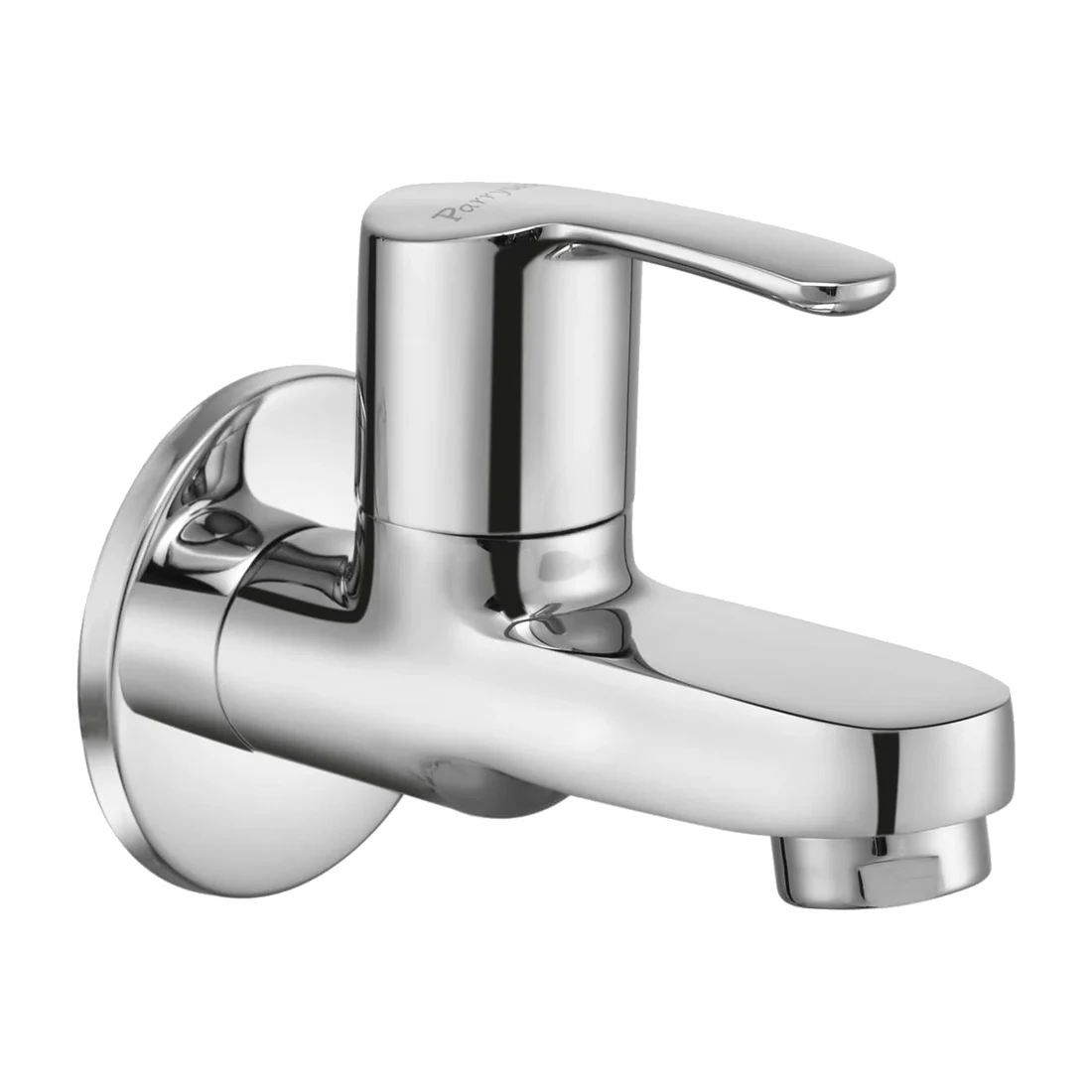
Praseo Bib Cock
Standard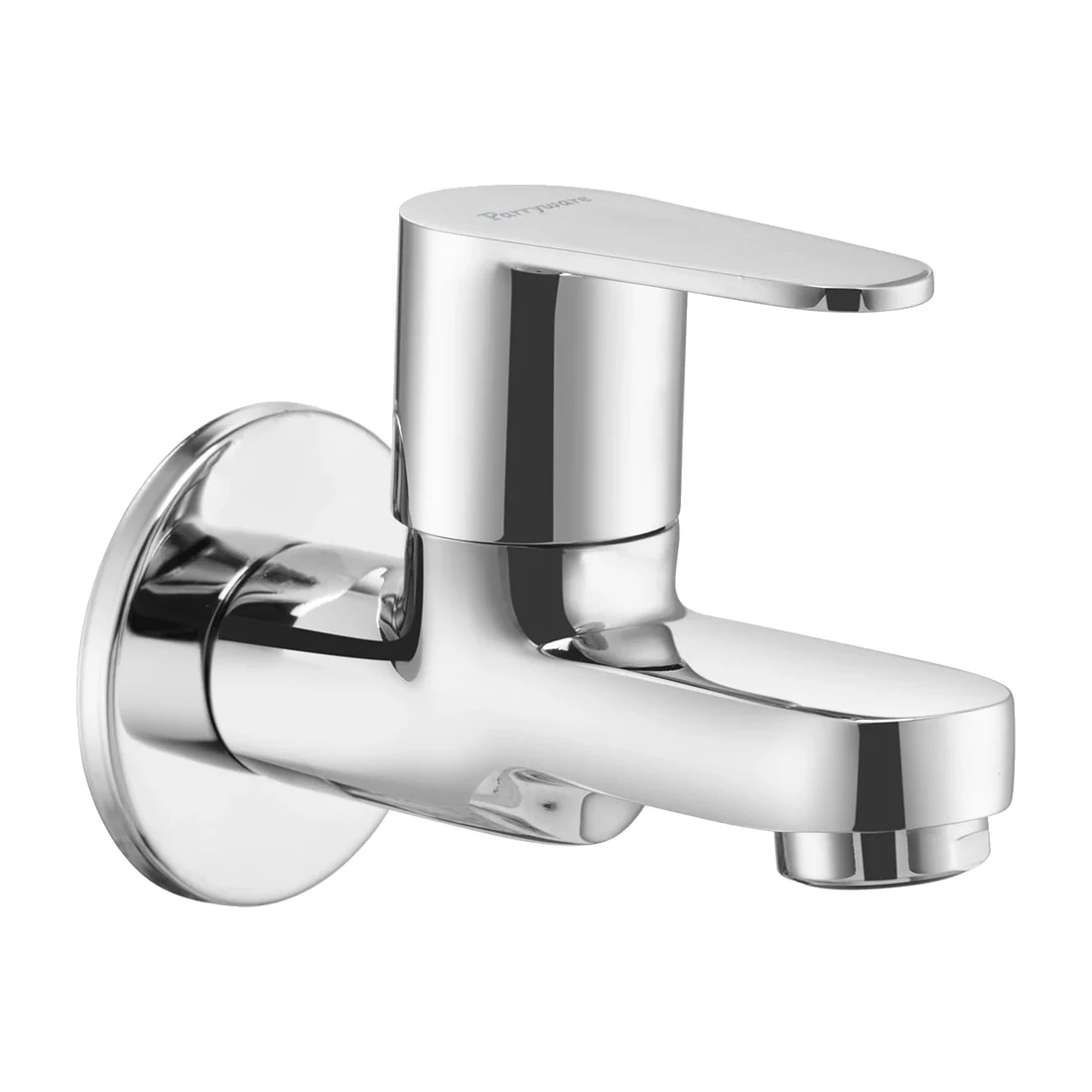
Uno Bib Cock G5004A1
Chrome
Sizing mistakes we see
- Reducing at the pump. A 1 1/4 inch pump outlet reduced straight to 3/4 inch to save on pipe. The pump works harder and fills the tank slower for its whole life.
- A small tank outlet. The tank nipple and the first valve set the size of everything after them. A 3/4 inch outlet on a tank that feeds a 1 inch down-take makes the down-take pointless.
- Chained 1/2 inch branches. One 1/2 inch line running from the WC to the basin to the shower, each taking off the one before. The last outlet on the chain starves when the first is open.
- Assuming "3/4 inch" is one size. 3/4 inch CPVC is 22.2 mm outside; 3/4 inch uPVC is 26.67 mm. They are different pipes with different bores. Our size chart has both.
- No valve per bathroom. Size aside, put an isolating valve on each bathroom's 3/4 inch feed so one leak does not shut the house. Our concealed valve guide covers the options.
What the sizes cost
Ashirvad CPVC pipe, per 5 metre length, our selling price before GST with the list price alongside, checked on 3 November 2026:
| Size | SDR 11, our price | SDR 11, list price | SDR 13.5, our price | SDR 13.5, list price |
|---|---|---|---|---|
| 1/2 inch | ₹325 | ₹650 | ₹285 | ₹569 |
| 3/4 inch | ₹435 | ₹870 | ₹409 | ₹818 |
| 1 inch | ₹673 | ₹1,346 | ₹598 | ₹1,195 |
| 1 1/4 inch | ₹1,152 | ₹2,303 | ₹984 | ₹1,967 |
| 1 1/2 inch | ₹1,581 | ₹3,161 | ₹1,361 | ₹2,721 |
On a typical house the step from a 3/4 inch to a 1 inch down-take is a handful of lengths at ₹673 instead of ₹435, plus fittings. The 1 inch elbow is ₹31 (list ₹62) and the 1 x 3/4 inch reducer coupler is ₹32 (list ₹63). Every size is on the Ashirvad price list, and our plumbing material cost for a 30x40 house shows these sizes priced line by line for a whole building.
Getting your sizes checked
Send us the floor plans, or just the number of floors, bathrooms and kitchens and where the tank sits, and we will suggest sizes and price the material. Use the quote tool, WhatsApp +91 99801 00987, or visit the counter in Viveknagar. The quote is free and we stock Ashirvad, Astral and Supreme CPVC in every size on this page.
Questions we get asked
Which size pipe is best for house plumbing?
There is no single size. In CPVC, 1 inch for the rising main and down-takes, 3/4 inch for floor runs and bathroom feeds, and 1/2 inch for the drop to each outlet is the pattern most Bengaluru houses use.
Is 1/2 inch pipe enough for a shower?
For the last short drop from a 3/4 inch bathroom feed, yes. A long 1/2 inch line feeding the shower and other outlets as well is where weak showers come from.
What size is the main water line for a house?
From the overhead tank, 1 inch for most independent houses, and 1 1/4 inch when one down-take serves two units or many bathrooms. The rising main from the pump should match the pump outlet.
Is 3/4 inch pipe better than 1/2 inch?
For anything that feeds more than one outlet, yes. Its bore is about 18 mm against about 12 mm, and at the same flow it loses roughly a sixth of the pressure per metre.
Pipe dimensions are from the Astral CPVC PRO catalogue; velocity and friction method from the Prince FlowGuard Plus manual; pump guidance from the Ashirvad CPVC technical manual; flow and residual head clauses from IS 2065. Checked on 3 November 2026. Prices are our selling prices before GST on that date.